

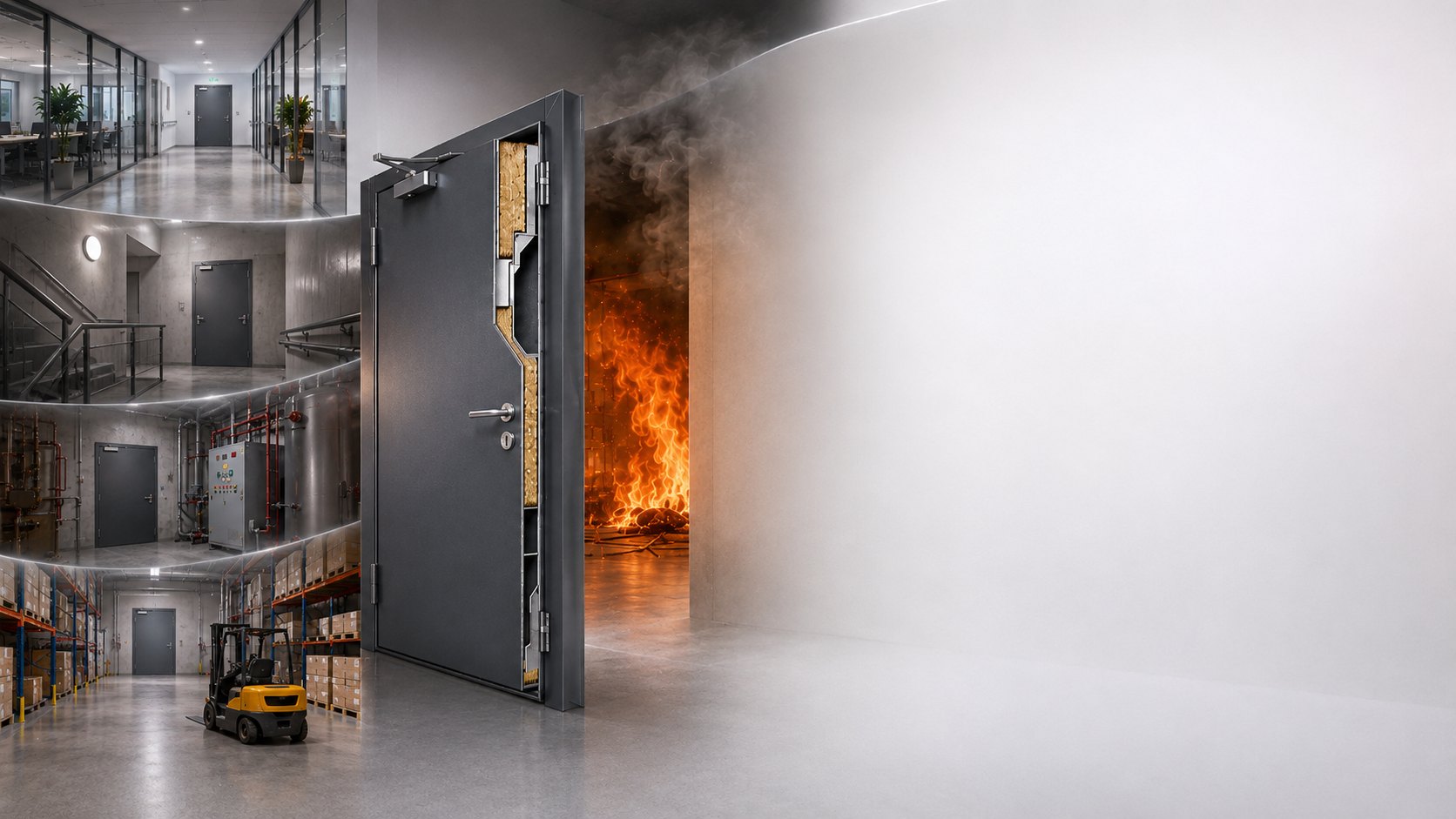
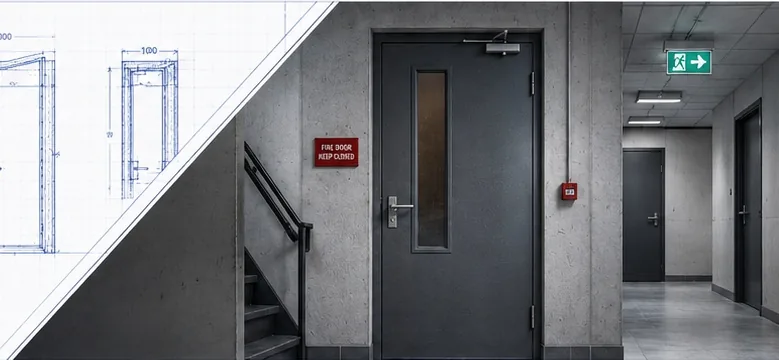
Popular fire-rated doors

One-and-a-half-leaf glazed fire-rated door EI30/EI60
Learn more
One-and-a-half-leaf fire-rated door EI30/EI60
Learn more
Double-leaf glazed fire-rated door EI30/EI60
Learn more
Double-leaf fire-rated door EI30/EI60
Learn more
Single-leaf steel fire-rated door EI30/EI60
Learn moreFire-resistance ratings
Fire-rated doors are classified by how long the assembly maintains integrity and thermal insulation.
- EI30 up to 30 minutes
- EI60 up to 60 minutes
- EI90 up to 90 minutes
- EI120 up to 120 minutes
E — integrity
I — thermal insulation
Where they are installed
- Stairwells and escape routes
- Boiler and plant rooms
- Basements and attics
- Warehouses and production sites
- Car parks and garages
- Offices and public buildings
Construction features
Fire resistance is provided by multi-layer infill, intumescent seals and heat-resistant hardware.
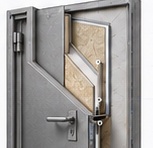
- 01 Steel door leaf
- 02 Fire-resistant infill
- 03 Intumescent seal
- 04 Reinforced door frame
- 05 Certified hardware
Benefits
- Protection of people and property
- Compliance with safety requirements
- Reduced smoke spread
- Strong steel construction
- Long service life
- Choice of sizes and configurations
Need advice?
We will recommend a solution that meets your project and safety requirements.
Key takeaways
- EI30, EI60, EI90 and EI120 ratings are available depending on the selected model.
- Steel construction, fire-resistant infill and seals help limit the spread of fire and smoke.
- Baltijas Durvis helps select the configuration and provides delivery and installation across Latvia.
Frequently asked questions
Ratings and purpose
How to read the classification and understand the intended use.
What do EI30, EI60, EI90 and EI120 mean?
E means integrity: the ability to resist flames and hot gases for a stated period. I means insulation, while the number is the classification time in minutes. Smoke-control performance is tested and classified separately. The order must follow the designation stated in the project and in the classification documents for the specific doorset.
How do I choose the required EI rating?
The rating should not be chosen only by room type or by adding an arbitrary safety margin. It is defined by the design, fire compartment, building use and requirements for the specific opening. Confirm the full classification, opening size and intended use with the responsible project specialist before ordering.
Where are fire-rated doors installed?
They are used in openings within fire-separating elements, protected escape routes, stairwells, plant rooms, warehouses, production sites, car parks and public buildings. The required rating and any smoke-control requirement for a particular location are defined by the project, not by a generic room list.
How is a fire-rated door different from an ordinary steel door?
Fire resistance applies to a tested and classified assembly: leaf, frame, seals, hardware, fixings and installation solution. A steel skin or non-combustible core alone does not prove a rating. An ordinary steel door without the relevant documentation cannot be claimed to have EI or smoke-control performance.
Does a fire-rated door also protect against burglary, cold and noise?
Not automatically. Fire resistance, smoke control, burglary resistance, thermal transmittance and acoustic insulation are separate characteristics. If the project requires several of them, each performance must be declared for the specific door configuration and intended use.
Selection and design
The opening, wall, equipment and other details to confirm before ordering.
Can I choose the size, glazing and hardware?
Yes, provided that the selected configuration is within the field of application of the specific doorset classification and is permitted by the manufacturer. Maximum sizes, glazing layout and area, locks, closers and other hardware vary by model. These options must be checked before the price and order are confirmed.
Why is it important to buy the complete doorset?
The classification applies to the tested assembly, not only to the leaf. The frame, seals, hinges, lock, closer, glazing and fixings work together to provide the declared performance. Substituting or adding components without approval may fall outside the classification and the manufacturer's installation instructions.
Can a fire-rated door be installed outdoors?
Only if the model is intended for external use and, in addition to fire performance, declares the required weather, water, air and thermal characteristics. Protection from rain and corrosion must also be considered. Whether an external opening requires fire resistance is determined by the project and the applicable LBN requirements.
Does the wall construction matter?
Yes. The doorset classification and installation documents identify the supporting constructions to which the result applies, such as a rigid or flexible wall with stated properties. A solution tested in concrete cannot automatically be transferred to a plasterboard partition without appropriate evidence.
How should the opening be measured?
Record the structural opening width and height at several points, wall thickness and material, finished-floor level, opening direction, hinge side and available hardware clearance. The clear passage after installation is also important for escape routes. A professional site survey is recommended for non-standard openings.
What is the opening direction and why does it matter?
It defines the leaf movement and hinge side, affecting escape, clear passage width and hardware placement. LBN 201-15 requires escape doors to open in the direction of escape, subject to the exceptions stated in the regulation. Once the design is approved, the direction must not be changed without review.
Can fire-rated doors be timber or fully glazed?
Yes. A fire-rated doorset may be steel, timber, aluminium or largely glazed if that construction has been tested and classified. The glass type, size and fixing method, together with the framing solution, form part of the documented configuration and cannot be changed freely.
Use and equipment
How to preserve the tested doorset performance during everyday use.
Can a fire-rated door be kept permanently open?
The door must normally be able to close automatically. It may be held open only by a device included in the design that reliably releases it on a fire signal or power failure. Wedges, cords and other physical obstructions prevent the door from performing its protective function.
Can I replace the lock, hinges or closer myself?
Not without a compatibility check. The replacement must be permitted by the door manufacturer's documentation or supported by the relevant classification and instructions. Even visually similar hardware may differ in fire performance, loading and operation, so replacement should be handled by a competent service provider.
Can the door be drilled or fitted with additional equipment?
Only at locations provided by the manufacturer and with permitted components. Drilling may damage the core, seals, glazing fixings or reinforcement and alter the tested construction. A compatible technical solution is required before installing access control, a viewer, cabling or any other device.
Can a ventilation grille be installed in the door?
Only if the specific grille and installation method are included in the tested or extended-application configuration of the doorset. An ordinary ventilation grille breaches the fire separation. Ventilation is often handled by a separately designed system with its own fire-resisting closure.
Can an access-control system be installed?
Yes, if the lock, cable transfers and fixings are compatible with the specific doorset and the system does not obstruct self-closing or escape. The design must address safe release, behaviour on power failure and any required interface with the fire alarm system.
Can a fire-rated door be repainted?
Only in accordance with the manufacturer's maintenance and finishing instructions. Identification markings, intumescent or smoke seals, moving parts and operating gaps must not be painted over. Check the permitted coating, surface preparation and film thickness before repainting.
Installation, documents and service
Handover, documentation and what to do if the door stops working correctly.
Do you provide delivery and installation?
Yes. Baltijas Durvis provides advice, delivery and professional installation across Latvia. Before preparing the offer, we check the opening, wall type, configuration and project requirements so that the installation solution follows the documentation for the specific doorset.
What should be checked after installation?
The door must open freely and fully close from the intended positions, the leaf must latch, and seals must remain continuous and undamaged. Checks also cover gaps, fixings, the closer, closing sequence for double leaves, threshold, escape hardware, identification marking and installation records.
What should I do if the door no longer closes fully?
Do not disable the closer, trim the leaf or alter the frame geometry. Possible causes include hinge settlement, closer adjustment, damaged seals, a dirty threshold or deformation. The protective function may be compromised until the fault is corrected, so contact a competent service provider.
Which documents should be supplied with the door?
The package must identify the product and its declared performance. It normally includes the declaration of performance, classification information, marking, installation, use and maintenance instructions, and permitted-hardware data. CE marking applies where a harmonised standard covers the product and intended use. Installation records and warranty documents should also be retained.
Certification
Solutions with stated EI ratings.
Individual approach
Configurations selected for the project.
Installation
Professional installation on site.
Warranty and service
Support after installation.
Across Latvia
Delivery and installation in different regions.