
Blog
Travel-inspired styles. How to match doors to individual styles?
Travel inspires. Also in interior design. For those dreaming of interiors referencing the cool North or exotic Asia, we recommend Krzysztof Miruć's advice. Here is an overview of interior styles inspired by Scandinavian, Indonesian and Japandi styles. How to recognize the Hampton style and the Mediterranean style? Let us remember that in addition to shades of blue, navy and white, natural and even distressed wood also appears in them. Shades […]

Travel inspires. Also in interior design. For those dreaming of interiors referencing the cool North or exotic Asia, we recommend the advice of Krzysztof Miruć. Here is an overview of interior styles inspired by Scandinavian, Indonesian, and Japandi styles.
How to recognize the Hampton style and the Mediterranean style?
Let us remember that in addition to shades of blue, navy, and white, natural, even distressed wood appears. Shades of beige and brick elements in ceramics. Patterned, thickly woven fabrics also appear. Everything must be natural, in earth tones, off-white, interwoven with navy and blue. If we want to bring something like this into our own home, we must remember that all accessories and styles require consistency. If we buy only individual elements, it may not work in the interior.
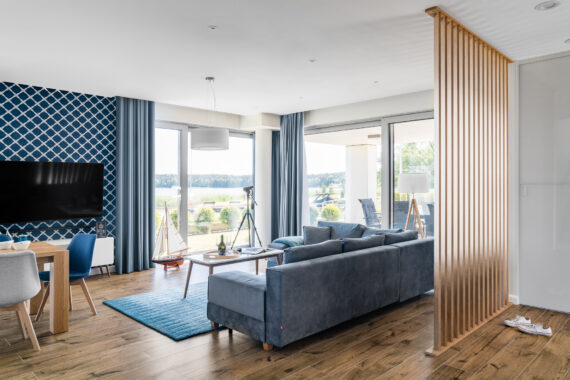
Natural fabrics and blue are the quintessence of the maritime style | design: Estera and Robert Sosnowscy
Such a style, more than for an apartment in the city center, suits a holiday home or a house outside the city. If we want to introduce it into an apartment, it is best in one closed room, e.g., a bedroom.
And what doors should be chosen for such a space?
Certainly panel doors, shadow-groove doors, frame doors. Navy or white doors from the DRE Supreme, Hampton model or milled doors DRE Nestor 10.
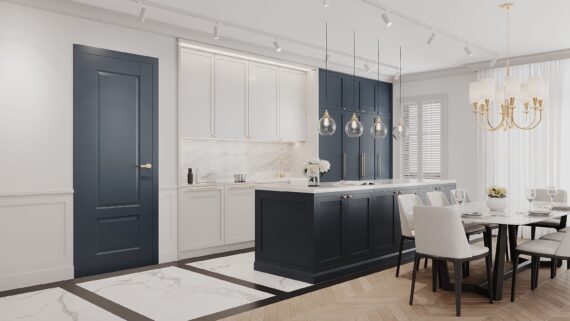
DRE Supreme model Hampton
Poles have fallen in love with the Scandinavian style. We supposedly know how to recognize it, but maybe it has some unique features that we have forgotten?
This style has already begun to live its own life. Although it is a very simple, minimalist style, with a lot of natural wood, white, and gray, increasingly other versions of it can be found. Combined with black or navy, it creates the Nordic black style. Poles have fallen in love with this style for its simplicity.
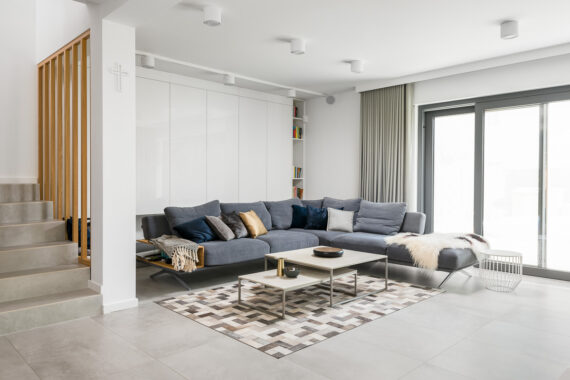
Gray, white, and wood are the quintessence of Scandinavian simplicity | interior design: Marta Kalinowska
Such interiors are quite easy to arrange and difficult to spoil. Sometimes it is enough to tidy up a bit and get rid of some things to find that we already live in the Scandinavian style.
So, for the Scandinavian style, should we choose specific doors, or in this case do we have more freedom?
For Scandinavian interiors, I would choose simple white or gray door leaves (e.g., Binito 60 in ash gray) and those with a wood-inspired decor.
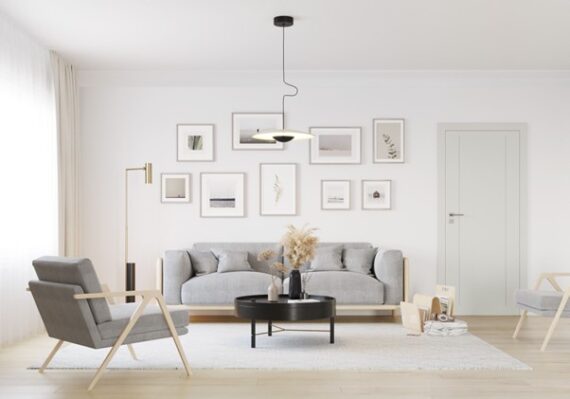
DRE Binito 10 in a Scandinavian-style living room
We change continents and take a journey east. Please tell us about the style inspired by Indonesia and Bali, as well as the popular Japandi.
In the japandi style, we play with one shade and tone, but many textures. Several paints must appear, light and shadow, but everything must be made from a single, whitened color. Indeed, these are very minimalist interiors, with many woven textures and wicker panels. It is very beautiful, but it requires consistency in furnishing the entire room.
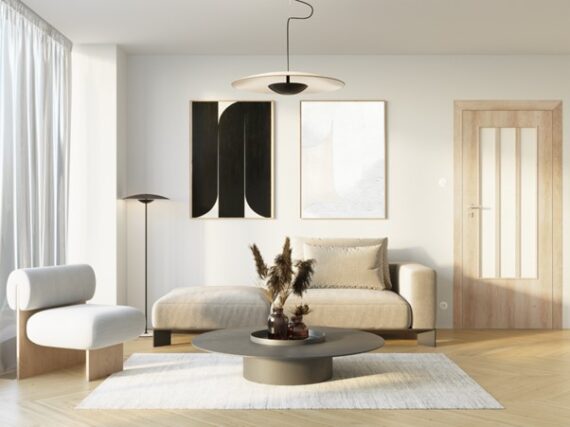
A Japandi-style living room with DRE Arte 30 doors.
It is therefore worth asking yourself whether we will be consistent when introducing japandi into the interior. In the japandi style, concealed doors work best, such as Sara Eco 2, but also tall leaves, e.g. the Soho 5, model in a non-standard height of 230 cm.
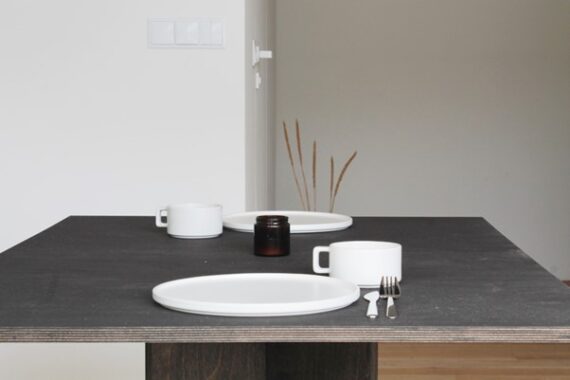
A concealed door leaf suits the japandi style | design: Karolina Golińska, Sara Eco 2 model.
In an Indonesian interior, we can be more daring. Dark colors and dark accessories can appear there, and old wood must be present. For such an interior, I would choose frame doors in nice colors, e.g. Estra 5 in olive. Let us remember, however, that all the styles mentioned are ones we like very much in photos or during a trip, but we will not transfer them to our own home. Even if we like it very much, could we live in such a space? Probably not. We will rather head toward Provence, a slightly aged table, ceramic accessories, white furniture.
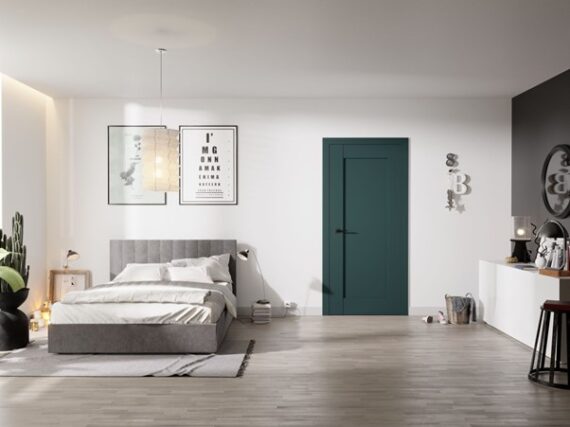
DRE Estra 5 in olive
Can individual styles be combined or mixed with each other?
Style is really a set of rules, a canon, around which one must move very consistently. When styles in architecture were invented, they were based on canons and rules that could not be broken. They evolved slowly, an intermediate period came, and then another style. Now, however, we furnish interiors to create a mood in them, not to cling rigidly to rules. If we feel like creating a jungle mood or a minimalist japandi and we will feel good in that interior, then let's do it. Let's not be afraid. There are no style rules we must follow, because we build them for ourselves.
The holiday season is in full swing. How to look for inspiration during summer travels?
Of course travel educates, but I always wonder why people bring back souvenirs and put them at home. If you do not have a nice shelf where you can display them, they often end up on various tables, cluttering the space. In such an interior, it is hard to relax.
I think that often, instead of souvenirs that will collect dust for us, it is better to bring back a lot of memories. If we want to be inspired by travels, it is best to create one room at home in that mood: a bathroom, bedroom, or home office. It will be an interior where we spend some time, but we will not be oversaturated with it. Then we will have more joy and memories after such a trip.