
Blog
How to brighten up an interior?
Lighting is much more than a pendant lamp in the central point of an interior. Well-chosen lighting will brighten the space, give the interior character and emphasise the furniture and accessories. How to plan lighting in a home? Will doors help to illuminate a room? Krzysiek Miruć answers. What functions does lighting serve in an interior? We are beings who live during the day, not at night. […]

Lighting is much more than a pendant lamp in the centre of the interior. Well-chosen lighting will brighten the space, give the interior character and highlight the furniture and accessories. How to plan lighting in a home? Will doors help to illuminate a room? Krzysiek Miruć answers.
What functions does lighting serve in an interior?
We are beings who live during the day, not at night. We need light in the interior to live. Daylight is sometimes more, sometimes less, depending on the time of day or the architecture of the interior. Unfortunately, it also does not create atmosphere. That is why lighting is so important. It should fulfil several functions. First of all, obviously, it must fill and brighten the space. On the other hand, it should give the interior atmosphere. We must remember this when choosing lamps or lighting systems.
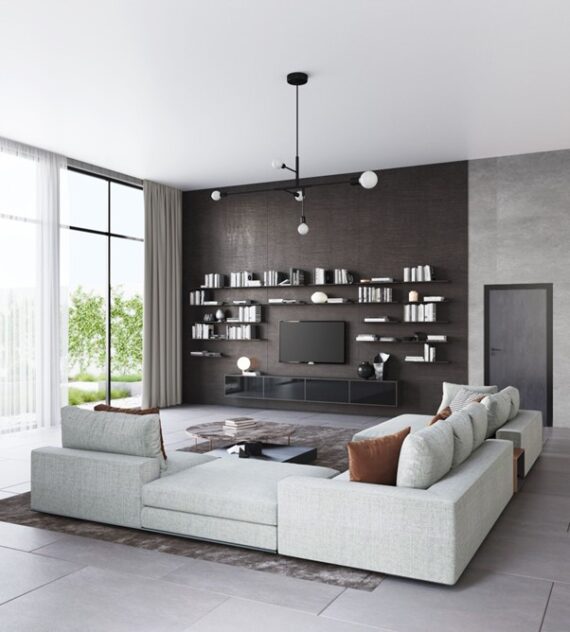
Large windows are a natural source of light | doors in the visualisation: DRE Nova Cell 10
Can daylight be controlled by arranging the functions of the interior according to the cardinal directions?
In an ideal world, yes. It is assumed that in Poland the daytime area should be located on the southern side, and the less used areas, such as the bathroom or utility rooms, where we spend much less time, on the northern side. For the pleasure of getting up in the morning, it is best to locate the bedroom on the eastern side. However, this is a purely academic assumption. In practice, when designing a house or multi-family housing, cardinal directions are not key determinants. Other variables come into play, such as the neighbourhood or view axes.
So, returning to what we can influence, namely artificial lighting. Few people probably know that it has colours. Please tell us how to choose the colour of light for an interior.
The colour temperature of light is measured in Kelvins. The lower the value, the warmer the shade of light. Formerly, the most popular filament bulbs had 2700 K. Today, the dominant light is 3000 K. This is a warm shade, ensuring relaxation, in which our skin looks nice and healthy. It will therefore work perfectly at home. 5000 K is light similar to daylight, so I usually recommend it for offices, where we want to extend the day and the light is to make work easier. In a home space, we want it to be warmer and the colours more cosy. There are also people who like cool light at home and that is also fine, because I always encourage playing with light. However, you must not mix shades of light in one room, because then we see that something glows white or blue, and something else even yellow. Colour consistency guarantees that textures will be lit the same and colours will look good.
It is said that colour only shows on the wall. Can lighting change the colour of the interior, furnishings or accessories?
Of course it can, which is why we choose all finishing materials in daylight, not in the sun but in shade and in neutral light. We also do a test, i.e. for example we go home and hold all these elements against the wall to check how they look in our interior. It very often happens that the most beautiful sofa in the living room or the colour of the wall on the sample will not look good in our interior. Let us remember that many factors affect colour. What is outside the window, whether light reflects off another building, how our windows are finished, which side of the world we have outside the window, whether there are trees. All this affects colour and we must pay attention to it.
How to design lighting in an interior. How many light points should we have so that they are functional and give atmosphere?
It depends on the interior. I always repeat that the greatest harm to a room is a single lamp hanging in its central point. Such an arrangement does not illuminate the interior; there is always too much or too little light. When entering a hotel, we usually have the entire space very softly lit. If we want to work, we will also find a place with appropriate lighting. Similarly in our homes. If we are together with our other half in the kitchen and she wants to cook while I work on a laptop at the table, we illuminate the interior with a lamp above the table and above the kitchen counter. A single, central lamp will neither illuminate the interior nor give it atmosphere. It is better to play with light to design a scene not only in one room, but also in entire parts of the apartment.
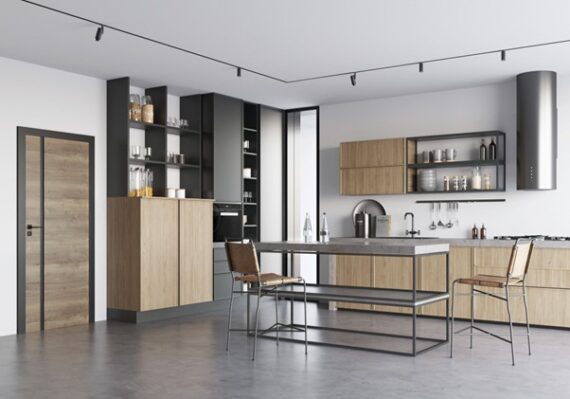
For convenience during cooking, the worktop should be evenly illuminated
In the bedroom, we only need semi-darkness, warm, pleasant light from floor lamps by the bed or wall sconces hanging above it. Then we do not get tired; above all, our eyes do not get tired. Both in the morning, when we get up during the autumn-winter period, and when we go to bed after dark, we do not need light that shines directly into our eyes. This rule also applies to the kitchen or bathroom. The light above the kitchen counter should shine on the counter, not on our face, and we should not cover that light with our whole body. The same applies to the bathroom. The light should be diffused so that it evenly illuminates the face, not from above or below, because then we have shadows.
The second problem is light fixtures whose light source shines directly into our eyes. It is such a strange way of thinking that if I see a light bulb, it means it lights nicely. But in fact, it is the shades that diffuse and soften the light source, filling the entire interior, that light nicely.
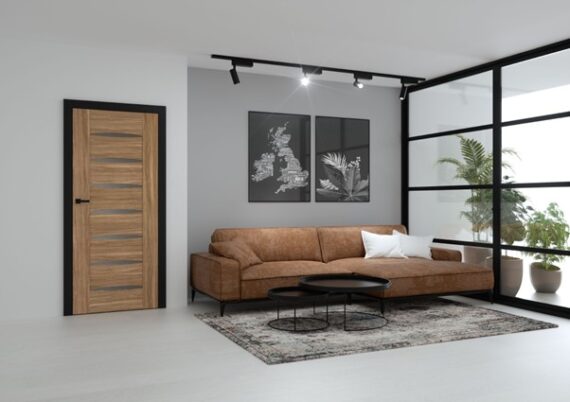
Light directed at the wall will illuminate hanging decorations | in the visualisation, DRE Ena 0 doors
In an interior, we must have at least two lighting scenes. On the one hand, one where we relax, we can enjoy a light semi-darkness, and a second scene where the lighting fills the space. Light necessary for work, cleaning, or illuminating the place where children play.
Table or decorative lamps that are turned on from a switch are a very interesting solution. When entering a room, we usually have a switch for the main light, but we can design it so that sockets also turn on. This will make our life easier and the interior will immediately fill with pleasant, warm light.
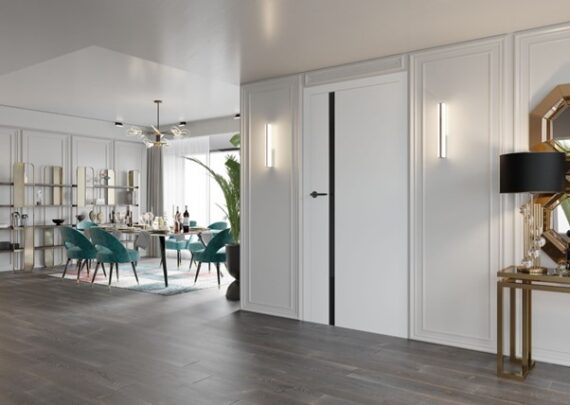
It is worth planning lighting in the living room controlled from the hallway | doors from the visualisation: DRE Vetro E
We also need to move away from the mindset that I enter a room, flip one switch, and one room is bright while the other is not. It is much nicer to return to an apartment that is fully illuminated from the threshold. It is worth designing the lighting so that with one switch you turn on the light in the main rooms, and then with other switches you illuminate the space for work or relaxation.
Can doors with glazing illuminate a dark room, a narrow hallway, or a bathroom without a window?
It is not entirely true that glazing illuminates the interior. They create atmosphere when light passes through them. They make an additional decorative element appear on the darker side in the form of a glowing surface, a smaller or larger glowing decor. At the same time, it allows you to maintain comfort and intimacy, because through the closed door leaf you cannot see what is happening in individual rooms.
Let us remember, however, that light passes through glazing in both directions. If we decide on doors with large, frosted glazing, we still have to plan lighting in it. Then the light turned on in the hallway will illuminate the interior of the rooms, which may affect the comfort of family members resting in them.
When choosing doors for the home, we can also use transparent glazing. They will not provide privacy in individual rooms, but they will illuminate them. Therefore, they will work well in interiors that we want to visually connect, e.g., a kitchen with a living room. Transparent glass makes the spaces begin to interpenetrate.
How can we brighten a room using various decorating tricks, e.g. mirrors? Do you have any tips for that?
First of all, I want to debunk the myth that mirrors and glossy surfaces brighten a space. Designers use them when they want to visually enlarge an interior. However, we can use another trick that allows us to double windows and reflect the daylight coming in from outside. It is enough to finish the wall perpendicular to the window with mirrors. This effect, however, only works during the day, when daylight enters the interior.
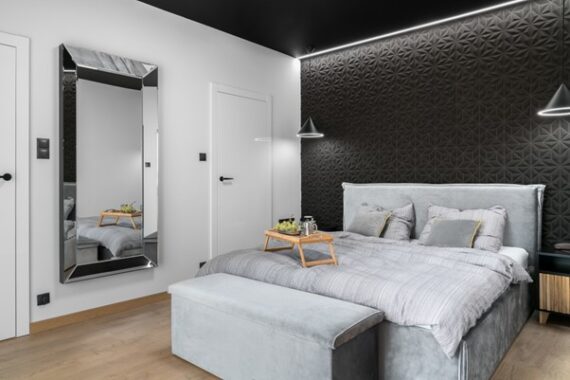
A mirror perpendicular to the window reflects light and visually enlarges the interior | visualization by Estera and Robert Sosnowscy – door model Silia 10.
Let us remember, however, that we can use light to illuminate some things. For example, LED strips behind a curtain make the window decoration elements become large windows. Light that is hidden can turn some interior elements or architectural elements into a lamp. In the case of suspended ceilings, the light source is placed in such a track, and thanks to this the room is illuminated with reflected light; often spot lighting is also added, which illuminates our paintings.
We already know how, so now tell us when to start planning lighting in the interior.
Only at the stage of creating the interior design! It is like deciding whether we will have two or three rooms or an open kitchen or not. We plan the light right away.