
Blog
How to Choose a Door – Glossary of Terms
Choosing door leaves is much more than style and color. What should guide you when buying them? How to distinguish right-hand doors from left-hand doors? How do rebated doors differ from rebate-free doors? In the latest interview, Krzysztof Miruć explains the issues essential when choosing a door leaf for your home. Before starting the renovation, during it, or maybe after it's finished? On which [...]
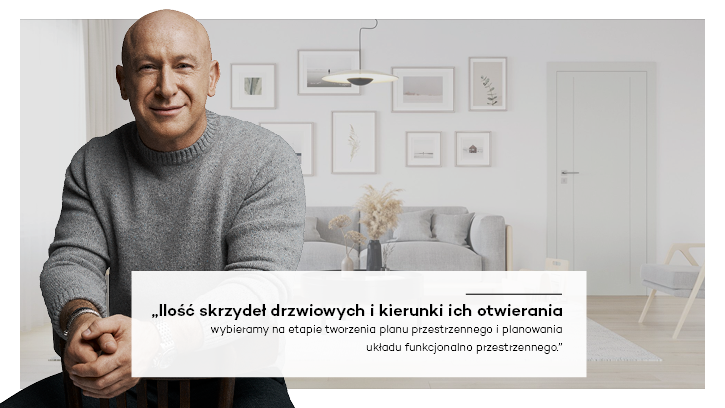
Choosing door leaves is much more than style and colour. What should guide you when buying them? How to distinguish right from left doors? How do rebated doors differ from rebate-free doors? In the latest interview, Krzysztof Miruć explains the issues essential when choosing a door leaf for your home.
Before starting the renovation, during it, or maybe after it is finished? At which stage of the work should you choose a door leaf for a house or flat?
We choose the number of door leaves and their opening directions at the stage of creating a spatial plan and planning the functional and spatial layout. We determine how many rooms the flat has, what circulation it has, in which direction the door leaves open and what their widths are. The standard width and height of a door is 80 x 205 centimetres. Doors to a bathroom or wardrobe can be narrower. Here, door leaves with a width of 70 – 80 cm will work well. Therefore, we choose the doors at the design stage, and install them after the floors are finished, at the furniture installation stage.
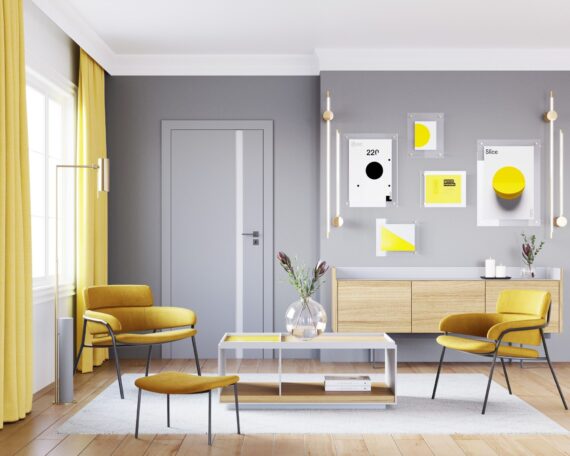
Right and left doors – how do they differ?
This is a very simple rule. It is determined by the hinge mounting side, so left-hand doors have hinges on the left side and the handle on the right, and I open them with my left hand. Right-hand doors have hinges on the right side and we open them with our right hand, and the handle is on the left side.
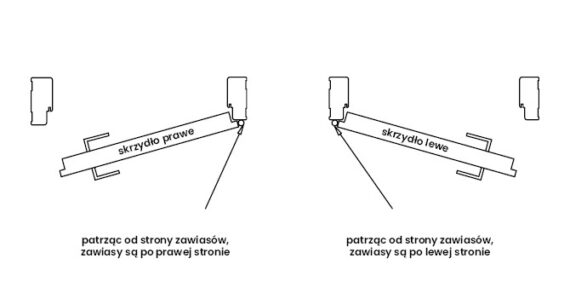
Door opening directions
How do rebate-free doors differ from rebated doors?
Rebate-free doors form a single plane, a single monolith; there is no step on the edge. The doors are flush with the plane of the architraves on the opening side. This is an increasingly common solution because it is aesthetic and suits minimalist interiors.
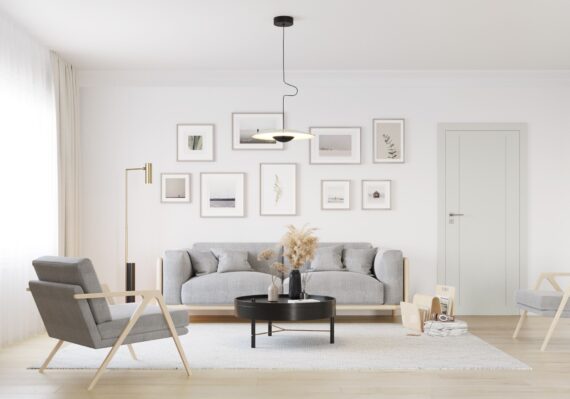
The Binito model offers the option of a reverse rebate
So on which side of the room, outside or inside, should this flush alignment with the wall be?
In theory, the flush alignment should be on the side of the more important room. Sometimes it happens that the door leaves in the hallway are all flush, but from the bedroom they open inwards and these are reverse doors.
Exactly. Doors with a reverse rebate. What does that mean?
These are otherwise known as reverse doors. These doors are flush with the plane of the wall, with the door frame, but they open into the reveal.
Painted doors, foil-covered or wallpapered and primed – how do they differ?
They differ simply in the method of finishing; it is a different material. Painted doors in the DRE collection include, for example, the popular model DRE Berge or DRE Binito. On the other hand, models from the DRE Supreme line are covered with foil, thanks to which the doors have a matte surface. Doors covered with primer (e.g., DRE Sara Eco 2) are prepared for painting with any wall paint or wallpapering.
Magnetic and standard locks. Which to choose and how do they differ?
Magnetic locks are those in which the latch pops out when the door is closed, so when the door is opened, nothing protrudes from the edge of the leaf.
The handle is also an element of the door. How to choose it?
Let's choose what we like and what we want. There are no rules. We can freely combine minimalist, modern handles with classic door leaves and vice versa. To simple door leaves, match a distinctive handle. We play with it; it's jewelry. Every woman knows how to match jewelry to an outfit, and I am sure she will just as well match handles to doors.
Frame color. Same as the door, or maybe darker or lighter? How to choose?
Freedom. Doors become more graphic if we choose a frame in a different color. Doors with a contrasting frame include, for example, the Vetro E- Synchro collection or Nova- Synchro.
Undercuts for bathroom doors. Are they necessary and if the bathroom has a window, can we forgo them?
No, undercuts are necessary and I suggest they be in every bathroom because they provide proper ventilation for the room. Let's also remember that bathroom doors must open outward.