

A home begins with a warm door
Warmth, comfort and peace of mind for your home — in any weather
- Weather resistance Performs reliably in rain, snow and wind
- Long service life Keeps its shape and performance for decades
- Thermal insulation Keeps warmth in winter and cool in summer
Popular collections

No Glass
Doors without glazing — maximum privacy.
View collection ›
Modern
Contemporary design for urban apartments and houses.
View collection ›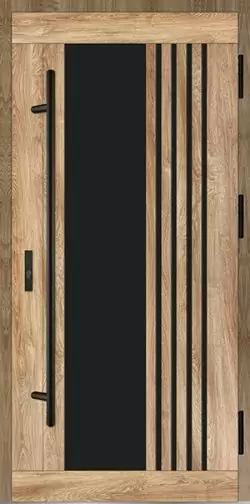
Smooth
Smooth surfaces and clean lines for minimalism.
View collection ›
Future
Modern doors with innovative solutions.
View collection ›
Classic
Timeless classics: strict forms and reliability.
View collection ›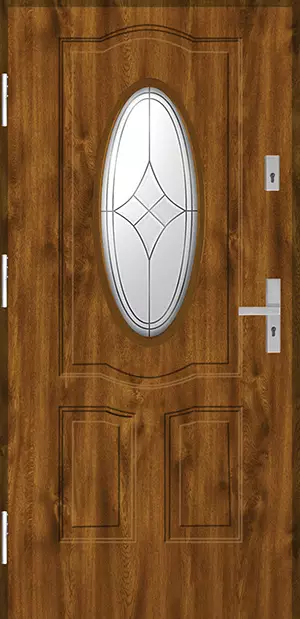
Traditional
Classic doors with a time-tested construction and finish.
View collection ›
Simple elegance
Doors with a minimalist design for a calm interior.
View collection ›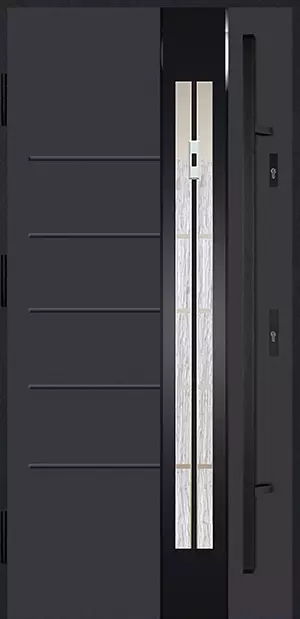
Diamond
Doors with expressive lines and premium materials.
View collection ›Frequently asked questions
Choice and materials
Metal or wood, thermal break, thickness and exterior finishes.
Which door is better for a private house: metal or wooden?
It depends on your priorities.
• Metal — maximum burglary resistance, durability and weather resistance.
• Wood — a natural look, eco-friendly materials and good thermal insulation, but it needs regular care and is less burglary-resistant.
In Latvia’s humid climate, most experts recommend metal doors with a thermal break or combined solutions.
What is a thermal break and why is it needed?
A thermal break is a heat barrier between the outer and inner parts of a metal door.
Why it matters:
• it prevents the metal frame from freezing through in cold weather;
• it stops condensation and ice forming on the inner face;
• it is essential for external doors without a warm vestibule.
What steel thickness is enough for a reliable door?
• For a private house — from 1.5 to 2 mm.
• For higher security — from 2 mm.
• The frame should be thicker than the leaf — this is a weak point on many doors.
Which finish is best for an exterior door?
Weather resistance matters most outdoors:
• powder coating — the most reliable option, weather-resistant, wide colour choice;
• MDF with a moisture-resistant PVC film (VINORIT) — for decorative looks;
• wood — only with a wide canopy and regular maintenance.
Security and protection
Burglary resistance, locks, quality signs and red flags.
Which burglary-resistance class should I choose for a house?
• RC3 — the practical level for most private homes.
• RC4 and above — for remote properties with a higher risk profile.
A higher class usually means a reinforced frame, stiffening ribs, anti-lift pins, quality locks and multi-point locking.
How many locks should an entrance door have?
Use at least two different lock types:
• a primary lever/safe lock with high burglary resistance;
• a secondary cylinder lock with drilling protection.
Both should be at least class 3. Multi-point locking is also recommended.
How can I tell that a door is high quality?
Check for:
• steel thickness from 1.5 mm;
• mineral wool or polyurethane core;
• at least two perimeter seals;
• two different locks of at least class 3, ideally with multi-point locking;
• reinforced hinges with anti-lift pins;
• a thermal break on exterior doors;
• CE marking and paperwork.
What red flags help avoid a poor-quality door?
Watch for:
• steel thinner than 1.2 mm;
• only one lock;
• no thermal break on an exterior door;
• a single seal contour;
• no anti-lift pins;
• missing CE marking and product passport;
• a price that is unrealistically low for the claimed performance.
Comfort and energy
Noise control, heating costs and weather protection.
Does an entrance door protect against noise?
Yes, but acoustic performance depends on:
• the number of seal contours (2–3 give a strong result);
• the core material (mineral wool usually performs better);
• how tightly the leaf sits against the frame.
In noisy areas, choose doors with at least 30–40 dB sound insulation.
Does the door affect heating bills?
Yes — often significantly.
• A poorly insulated door can let through up to 30% of heat loss.
• A quality door with a thermal break and a good core keeps heat in winter and cool air in summer.
• Lower heating bills mean long-term savings.
Do I need a canopy above the entrance door?
It is strongly recommended.
• It shields the door from direct rain and snow.
• It extends the life of the finish and seals.
• Recommended size: at least 2 m wide and 0.7 m deep.
Installation, sizes and service
Fitting, maintenance, custom sizes, storage and documents.
Can I install an entrance door myself?
Technically yes, but it is strongly discouraged.
• Poor installation causes misalignment, mechanism faults and lost insulation.
• The manufacturer may void the warranty after DIY fitting.
• Use certified installers instead.
How often should an entrance door be maintained?
• Lubricate mechanisms at least once a year.
• Inspect seals once a year and replace them if they lose elasticity.
• Adjust after the first 1–2 weeks of use and later as needed.
• Call a specialist immediately if the door squeaks or becomes hard to close.
Can I order a non-standard door size?
Yes. Most Latvian manufacturers make doors to custom sizes.
• Lead time is usually 5–6 weeks.
• A professional on-site survey is recommended.
How should the door be stored before installation?
• In a dry, ventilated room.
• Vertically or horizontally on packers of equal thickness.
• Do not place any objects on the door.
• Keep it in the factory packaging.
What should I do if the door no longer closes tightly?
Possible causes:
• hinge settlement (needs adjustment);
• worn or deformed seals (need replacement);
• frame distortion from building settlement or poor installation.
Solution: call a specialist for diagnosis and adjustment. Do not force a DIY fix — you can damage the doorset.
What documents should a quality door come with?
• A product passport with technical data.
• A warranty card.
• Installation and operating instructions.
• Conformity certificates (CE marking).
• An installation handover report when fitted by specialists.